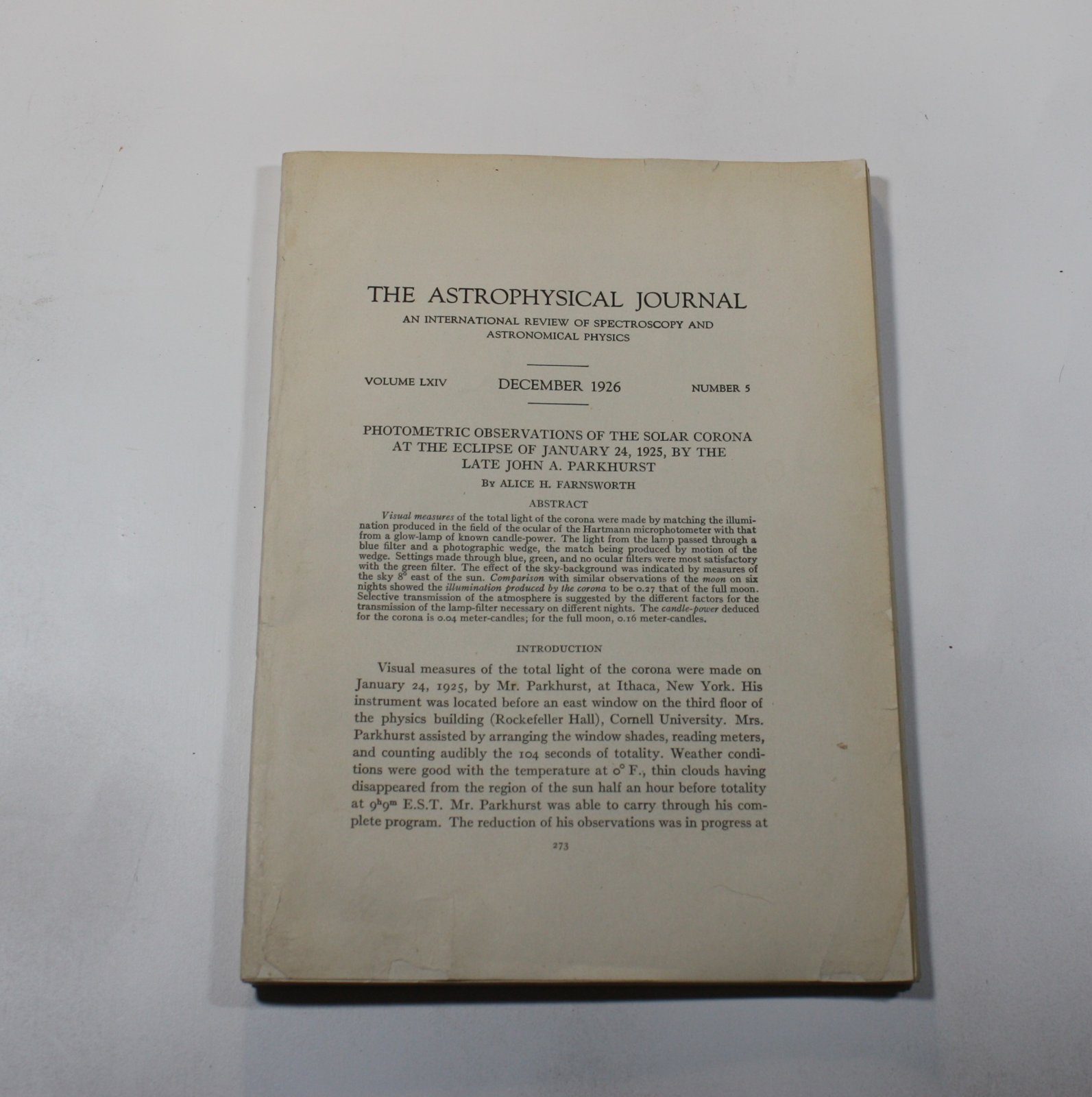
Extra-galactic nebulae
| Author | Edwin Hubble |
| Year | 1926 |
| Book language | English |
| Condition |
Good
|
Description
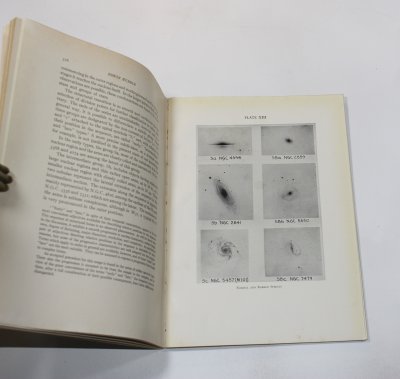
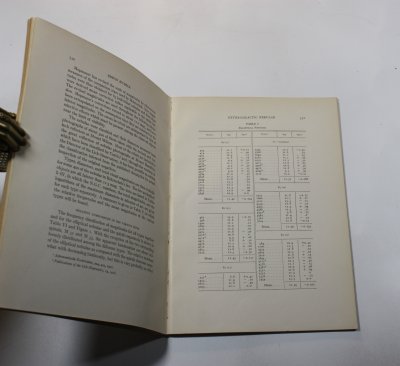
FIRST EDITION OF THE FUNDAMENTAL ARTICLE IN WHICH HUBBLE PRESENTS HIS CLASSIFICATION OF GALAXIES, ESTIMATES THEIR AVERAGE DENSITIES AND FOR THE FIRST TIME DERIVES THE AVERAGE MASS DENSITY OF GALAXIES IN THE UNIVERSE AS A WHOLE. THE ARTICLE IS "A MORE OR LESS COMPLETE DESCRIPTION OF GALAXIES AS EXTRAGALACTIC SYSTEMS. AND IT IS THE FIRST APPLICATION OF THE IDEAS OF RELATIVISTIC COSMOLOGY TO THE UNIVERSE OF GALAXIES" (Carnegie As02s). This article includes three plates and many tables. In this article, Hubble "determined the average density of nebulae in space and applied this result to the theory of general relativity to obtain the radius of curvature of the finite universe: 600 times the distance at which normal nebulae can be detected with the 10. This calculation represents the boldest probe of the universe and enormously stimulated theoretical work in cosmology" (Mayall, Hubble: A Biographical Memoir, National Academy of Sciences). The prophetic sentence in this article reads: "With reasonable increases in the range of plates and the size of telescopes, it may be possible to observe an appreciable fraction of Einstein's universe" (Hubble, 369). And he was right. Just three years later, Hubble would use the observational evidence gathered for this 1926 article to help formulate Hubble's law which, in asserting that galaxies are moving away from one another at a speed proportional to their distance, showed that the universe is in motion. While developing the morphological classification of galaxies presented in this article, "Hubble discovered a strange fact: all the galaxies he observed appeared to be moving away from Earth. Slipher, who had been measuring redshifts associated with galaxies more than a decade before Hubble. In other words, by 1926, Hubble already had "his good idea, that [the] data suggest a linear relationship between redshift and distance: that the redshift is proportional to the distances, such that a galaxy twice as far away has twice the redshift." Three years later, when he was ready, Hubble formulated Hubble's law, demonstrating that "galaxies recede from us at a velocity proportional to their distances from us: more distant galaxies recede faster than nearby galaxies, expanding," an idea that "has made as great a change in humanity's conception of the universe as the Copernican revolution 400 years before."