10 May 2026
Fra Mauro's Masterwork: A 1550 Florentine Edition That Shaped Renaissance Astronomy
Discover why Fra Mauro's annotated commentary on Sacrobosco's Spera remains one of the most sought-after astronomy texts of the Renaissance. This 1550 Florentine edition offers a fascinating window into 16th-century scientific thought.
The Legacy of a Medieval Astronomical Masterpiece
Giovanni de Sacrobosco's De Sphaera (On the Sphere) stands as one of the most influential astronomical texts ever written. Originally composed in the 13th century, this Latin treatise provided the foundational framework for understanding celestial mechanics and cosmology throughout the Middle Ages and Renaissance. For centuries, it served as the primary textbook in universities across Europe, making Sacrobosco's work essential to any educated person's understanding of the heavens.
Fra Mauro's 1550 Florentine commentary, however, represents something far more significant than a simple reprint. His extensive Annotationi (Annotations) transform Sacrobosco's medieval text into a living document of Renaissance scientific thought, incorporating centuries of astronomical observation and theoretical advancement that had accumulated since the original work's composition.
Why This Edition Matters to Collectors
Published by Lorenzo Torrentino in Florence—one of the period's most respected printers—this 1550 edition occupies a rarified space in the history of printed astronomy. Torrentino's Florentine press was renowned for producing works of exceptional quality, and this volume exemplifies his commitment to both textual accuracy and visual splendor. The inclusion of five full-page figures in the large fourth sphere on the title page, repeated again on page 208, demonstrates the technical sophistication of Renaissance printing. These astronomical diagrams, along with the numerous figures and schemata interspersed throughout the text, represent the cutting edge of scientific illustration in their time.
The reddening present in some sections—a characteristic of period aging—and the subtle halos visible in certain areas speak to this book's age and authenticity. Each mark tells the story of centuries spent in scholars' libraries, consulted by astronomers seeking to understand the cosmos.
A Bridge Between Two Worlds
Fra Mauro's annotations are crucial for understanding the intellectual transition of the Renaissance. Writing in the mid-16th century, he synthesized medieval Aristotelian cosmology with emerging observational astronomy. His commentary addresses not merely what Sacrobosco wrote, but how subsequent thinkers—including the giants of astronomical reform—had revised and expanded upon these ideas.
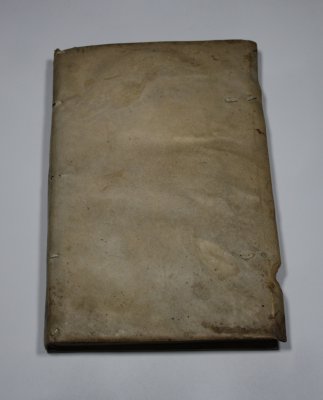
For collectors, this edition represents a tangible connection to the intellectual ferment of Renaissance Florence, a city that served as the birthplace of the scientific revolution. The volume's original vellum binding, carefully remounted to preserve this significant artifact, speaks to its value and the care invested in its preservation through the centuries.
A Precious Window into Scientific History
While wear marks and minor imperfections are visible—small spots and defects that come naturally with age—these characteristics only enhance the volume's appeal to serious collectors and historians. They authenticate the work as a genuine relic of the Renaissance period, not a modern reproduction.
For anyone passionate about the history of astronomy or the evolution of scientific thought, Fra Mauro's 1550 annotated edition of Sacrobosco's Sphaera offers an incomparable opportunity to own a piece of intellectual history. This is more than a book; it is a gateway into understanding how our ancestors mapped the heavens and questioned their place in the cosmos.
Works by this author in our catalogue