13 May 2026
Pickering's Photographic Atlas: The Rare First Publication That Revolutionized Lunar Cartography

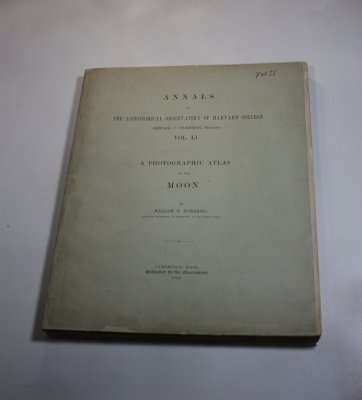
Discover the extraordinary rarity of William Henry Pickering's 1903 Photographic Atlas of the Moon, published through Harvard Observatory's annals before its official book release. This groundbreaking work represents a pivotal moment in astronomical history.
The year 1903 marked a watershed moment in the history of astronomy and lunar observation. William Henry Pickering's Photographic Atlas of the Moon, published as volume LI of the Harvard Observatory Annals, represented nothing short of a revolution in how astronomers documented and studied our celestial neighbor. What makes this particular edition extraordinarily significant—and remarkably scarce—is that it was the first and only publication of this comprehensive atlas through Harvard's official annals publication series, predating the more widely known book-format catalog edition released just a year later in 1904.
William Henry Pickering (1858-1938) was one of the most accomplished and prolific astronomers of the late nineteenth and early twentieth centuries. As director of the Harvard College Observatory and later founder of his own private observatory in Jamaica, Pickering devoted decades to systematic astronomical observation. His contributions to lunar and planetary astronomy were groundbreaking, and his meticulous approach to data collection set new standards for the field. The photographic atlas represented the culmination of years of dedicated observation and technical refinement.
What distinguishes this 1903 annals publication from its successor is not merely chronological precedence, though that alone makes it valuable. This edition represents the preliminary, more limited distribution of Pickering's work—circulated primarily among the international scientific community through Harvard Observatory's scholarly channels. The annals format was designed for academic institutions and serious researchers, resulting in a much smaller print run compared to the subsequent book edition. This fundamental difference in distribution explains why finding an intact copy of this specific 1903 annals publication has become remarkably challenging for collectors.
The atlas itself was a technical marvel for its era. Pickering employed the latest photographic techniques available in the early 1900s to capture unprecedented detail of lunar features. The photographic approach offered advantages over traditional hand-drawn observations: objectivity, reproducibility, and the ability to reveal details invisible to the naked eye through the telescope. For collectors and astronomy enthusiasts, owning this work connects them directly to a pivotal technological and methodological transition in astronomical science.
The rarity of this particular edition cannot be overstated. Many copies of scientific annals from this period were heavily used in institutional libraries, resulting in wear, damage, or loss. Some were rebound, altering their original characteristics. Others simply disappeared from public access. The specific combination of factors—limited initial print run, specialized distribution, over a century of handling, and the shift toward the 1904 book edition—has made this 1903 annals version increasingly difficult to locate in respectable condition.
For the discerning collector, this edition represents multiple layers of value: the importance of Pickering's scientific contributions, the historical significance of early photographic astronomy, the rarity of this specific publication format, and the aesthetic appeal of period scientific documentation. It stands as tangible evidence of how systematic observation, technological innovation, and scientific rigor converged to expand humanity's understanding of the Moon and the cosmos beyond.
This exceptional copy represents a genuine treasure for those who appreciate both the history of science and the artistry of early astronomical documentation.
Works by this author in our catalogue