10 July 2026
La Terre et la Lune: A Master Astronomer's Definitive Study from the Belle Époque

Discover Pierre Puiseux's landmark 1908 treatise on Earth and Moon studies, a beautifully bound volume from the prestigious Gauthier-Villars publisher that represents the pinnacle of Parisian astronomical scholarship.
A Monument to Lunar Science
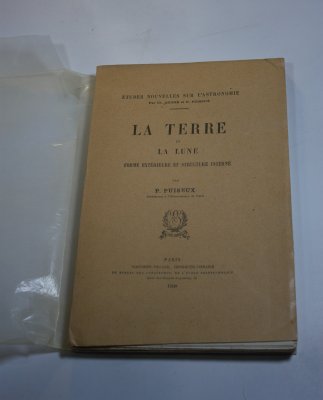
La Terre et la Lune, published in 1908 by the venerable Parisian house Gauthier-Villars, stands as a testament to the extraordinary achievements of Pierre Puiseux, one of the nineteenth century's most accomplished lunar astronomers. This magnificent volume, stretching across 176 pages enriched with 24 astronomical plates and 2 detailed maps, represents the collaborative vision of two of France's greatest astronomical minds: Puiseux and his colleague Ch. André, who directed the broader series titled "Nouvelles Études d'Astronomie" (New Studies in Astronomy).
Pierre Puiseux (1855-1928) dedicated his life to unlocking the mysteries of Earth's celestial companion. As a distinguished astronomer of the Paris Observatory, Puiseux became the undisputed authority on lunar geology and topography during an era when telescopic observation was revolutionizing our understanding of the cosmos. His meticulous work combined observational precision with theoretical elegance, making La Terre et la Lune far more than a simple descriptive catalog—it was a comprehensive synthesis of contemporary lunar knowledge.
The Significance of Puiseux's Work
The early twentieth century was a transformative period for astronomical study. While photography had begun supplementing visual observation, the art of careful, sustained telescopic observation remained paramount. Puiseux's expertise in mapping lunar features and understanding Earth-Moon interactions positioned him perfectly to author what would become a definitive reference. His work examined not merely the Moon's surface features but the profound gravitational and orbital mechanics governing the Earth-Moon system.
What makes this 1908 edition particularly precious is its production quality. Bound in half-vellum with decorative golden floral elements adorning the spine and a burgundy title label, this volume exemplifies the craftsmanship of Belle Époque Parisian publishing. The original publisher's covers remain intact—a rarity in books over a century old. The 24 astronomical plates, meticulously prepared through state-of-the-art printing techniques of the era, showcase lunar photographs and detailed illustrations that remain scientifically valuable today.
Why Collectors Covet This Edition
For serious collectors of astronomical literature, this volume occupies a special position. It bridges scientific rigor with aesthetic excellence, combining leather-bound elegance with genuine intellectual substance. The extensive illustrations embedded throughout the text, coupled with the separate cartographic materials, provide visual documentation of how astronomers understood the lunar landscape before the Space Age revolutionized our perspective.
The Gauthier-Villars imprint itself carries prestige—the publisher had established itself as France's premier scientific publisher, favored by luminaries including Poincaré and other leading natural philosophers. Books from their "Nouvelles Études" series represent the cream of Belle Époque scientific publishing.
Today, finding La Terre et la Lune in fine condition, with original binding intact and all illustrations present, represents a significant acquisition for collectors. It embodies the moment when lunar science transitioned from speculation to rigorous study, captured by one of history's great selenographers in a work of enduring beauty and substance.
Works by this author in our catalogue