3 July 2026
A Gateway to Newtonian Astronomy: John Keill's Introductio Ad Veram Astronomiam (1718)

Discover why John Keill's influential lectures on astronomy remain treasured by collectors, and learn about this Scottish mathematician's crucial role in defending Newton's revolutionary ideas against Leibniz.
The Man Behind the Lectures: John Keill's Legacy
John Keill (1671-1721) stands as one of the most influential yet sometimes overlooked figures in the history of astronomy and mathematics. Born in Scotland, Keill studied under the renowned David Gregory at Edinburgh, establishing himself as a brilliant mathematician and steadfast advocate for Isaac Newton's groundbreaking work. When Keill took the prestigious Savilian Chair of Astronomy at Oxford University, he brought with him not merely academic credentials, but a passionate commitment to propagating Newtonian mechanics at a time when the scientific world was fractured between competing claims and methodologies.
Keill's reputation during his lifetime extended beyond the lecture hall. He became embroiled in one of science's most bitter disputes: the question of who truly discovered calculus—Newton or Leibniz. With characteristic tenacity, Keill championed Newton's priority, arguing forcefully that Leibniz had plagiarized the great English mathematician's discoveries. This controversy consumed much of his energy, yet it also demonstrated his deep understanding of mathematical principles and his unwavering loyalty to Newtonian philosophy.
Understanding the Introductio Ad Veram Astronomiam
The Introductio Ad Veram Astronomiam seu Lectiones Astronomicae (Introduction to True Astronomy, or Astronomical Lectures) represents Keill's most enduring scholarly achievement. First published in 1718, these lectures delivered at Oxford crystallize the author's approach to teaching astronomy through the lens of Newtonian mechanics. Rather than presenting astronomy as mere observational cataloging, Keill integrated mathematical rigor with physical principles, showing students how celestial phenomena could be understood through mathematical laws governing motion and gravitation.
The pedagogical structure of these lectures made complex ideas accessible to educated readers, which partly explains their lasting influence. Keill's methodology—combining theoretical explanation with visual aids—proved remarkably effective for the era, and the text became a standard reference for astronomy students throughout the eighteenth century.
Why This 1718 Edition Matters to Collectors
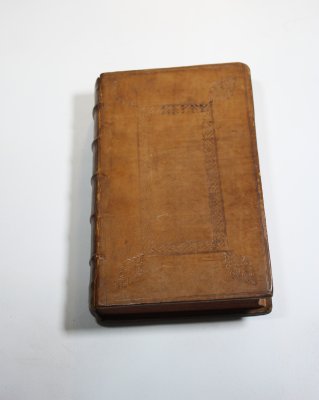
This particular edition holds substantial significance for serious collectors and astronomy enthusiasts. The contemporary calf binding (becerro) with its characteristic period binding style reflects the craftsmanship of early eighteenth-century bookmaking. The presence of two folded engraved plates depicting lunar landscapes and mathematical diagrams throughout the text represents crucial visual documentation of early modern astronomical observation and understanding.
The condition of this copy—internally clean and sharp with well-preserved binding—enhances its rarity and desirability. Seventeenth- and eighteenth-century astronomical texts faced heavy use in universities and observatories, making well-preserved copies increasingly scarce. The inclusion of those spectacular lunar landscape illustrations particularly elevates this copy's appeal, as such folded plates were vulnerable to damage and loss over centuries.
For collectors, this edition represents a pivotal moment in scientific history: the transition from classical Aristotelian astronomy to modern mechanistic understanding. Owning Keill's Introductio means possessing a tangible connection to the intellectual revolution sparked by Newton and defended by brilliant minds like Keill himself.
Works by this author in our catalogue