13 June 2026
Lunar Cartography Meets Imperial Science: Weinek's Groundbreaking 1901 Moon Study

Discover Ladislaus Weinek's rare 1901 masterpiece documenting lunar observations from Prague's Imperial Observatory. This exceptional volume combines astronomical rigor with stunning photographic reproductions, making it a treasure for both collectors and moon enthusiasts.
A Pioneer of Lunar Photography
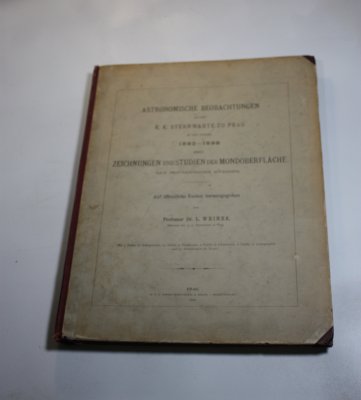
Ladislaus Weinek's Astronomische Beobachtungen der Mondoberfläche represents a pivotal moment in astronomical publishing—the convergence of scientific observation and photographic reproduction at the turn of the 20th century. Published in 1901 by the Imperial and Royal Court Press in Prague, this 131-page volume stands as a testament to Weinek's dedication to understanding our celestial neighbor during eight years of meticulous observation.
Weinek, a distinguished astronomer at Prague's prestigious Imperial and Royal Observatory, spent the years 1892-1899 systematically documenting lunar features through the telescope. What makes this publication extraordinary is not merely the observations themselves, but the exceptional quality of their presentation. The volume contains 18 meticulously crafted plates—three executed as heliogravures, two as lithographs, and thirteen as hardcover reproductions—alongside 12 detailed text illustrations that bring lunar topography to vivid life.
Technical Innovation in Scientific Publishing
The printing techniques employed in this volume showcase the cutting edge of early 20th-century publishing technology. Heliogravure, an intaglio process that yields museum-quality photographic reproductions, was an expensive and labor-intensive technique reserved for the most important scientific and artistic publications. The inclusion of three heliogravure plates suggests Weinek's drawings were considered of sufficient scientific importance to warrant this premium treatment—a rarity that dramatically increases the book's value and desirability among collectors.
The combination of photographic studies with hand-drawn interpretations demonstrates the hybrid methodology prevalent in pre-telescope-photography astronomy. Weinek's detailed lunar drawings, based on direct observation and enhanced by photographic evidence, provided fellow astronomers with an invaluable reference tool. These weren't merely artistic renderings; they represented hours of careful observation converted into permanent records suitable for scientific study and comparison.
Why This Edition Remains Exceptionally Rare
Several factors contribute to this volume's rarity in the collector's market. First, it was published as an autopublication through the Imperial Court Press—essentially a limited, self-published run rather than a commercial distribution. Second, its specialized subject matter and German-language text limited its audience to European astronomical circles. Third, the exceptional print quality and valuable materials used in production mean fewer copies survived intact through the 20th century.
The physical specifications—a generous 307 x 237 mm format—were designed to accommodate the detailed lunar charts without reduction, but this size made the volumes less portable and more vulnerable to damage and deterioration. Collectors today rarely encounter examples in good condition with all plates present and undamaged.
A Bridge Between Eras
This remarkable work occupies a fascinating position in astronomical history. It represents the final flourishing of visual lunar observation and hand-drawn interpretation before photographic astronomy would eventually dominate the field. For collectors, it offers a window into how professional astronomers worked at the turn of the century—combining rigorous observation with artistic skill and cutting-edge printing technology.
Whether you're a serious astronomy historian, a collector of rare scientific works, or an enthusiast of fine printing and reproduction techniques, Weinek's Astronomische Beobachtungen der Mondoberfläche deserves a place of honor. It is simultaneously a scientific document, a work of graphic art, and a historical artifact that illuminates both the moon and an extraordinary moment in scientific publishing.
Works by this author in our catalogue