11 July 2026
Martian Dreams in Early 20th Century Barcelona: Josep Comas i Solà's Visionary 'La vida en el planeta Marte'
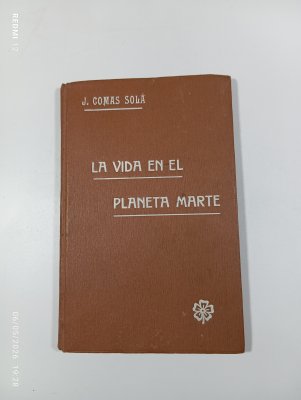
Discover one of the rarest astronomical works from early 20th century Spain. Josep Comas i Solà's 1914 'La vida en el planeta Marte' represents a fascinating intersection of scientific inquiry and imaginative speculation about the Red Planet.
A Glimpse into Martian Speculation at the Dawn of Modern Astronomy
In 1914, as Europe teetered on the brink of profound change, a Catalan astronomer named Josep Comas i Solà published a remarkable work that captured the imagination of Spanish readers fascinated by the mysteries of Mars. La vida en el planeta Marte (Life on the Planet Mars) represents a crucial moment in the history of astronomical literature—a time when scientific observation and speculative wonder could still coexist harmoniously on the pages of a single book.
Josep Comas i Solà (1868-1937) was one of Spain's most distinguished astronomers and founders of the Fabra Observatory in Barcelona. His credentials as a serious scientist lent tremendous authority to his observations about Mars, even as contemporary debates raged about the famous "canals" that Giovanni Schiaparelli had reported observing through his telescope. Comas i Solà's work synthesized the latest astronomical data available at the time while engaging readers with the tantalizing possibility of Martian civilization.
The Historical Context of Martian Fascination
The early 20th century represented the peak of public obsession with Mars as a potentially inhabited world. Percival Lowell's controversial observations of Martian canals had sparked decades of debate and speculation. Comas i Solà's 1914 publication positioned itself within this vibrant scientific discourse, offering Spanish-language readers a sophisticated exploration of what Mars might reveal about the possibilities of life beyond Earth.
Published by Ciencias y Letras and printed by Imp. Núñez in Barcelona, this illustrated edition measured 17 centimeters and comprised 102 pages plus 2 additional pages of front matter. The inclusion of period engravings and contemporary astronomical imagery transformed it from a mere text into a visual journey across the Martian landscape as imagined by early astronomers.
Why This Edition Remains Exceptionally Rare
Finding an original copy of La vida en el planeta Marte in good condition presents a genuine challenge to collectors and institutions alike. The original illustrated cloth binding has survived in remarkably few copies, as most working copies were either heavily used or discarded during the tumultuous decades that followed its publication. The Spanish Civil War (1936-1939) and subsequent periods devastated many Catalan collections, making pre-war Barcelona publications increasingly scarce.
The combination of factors—a respected author publishing a visionary work during a precise moment in astronomical history, beautiful period illustrations, and the vagaries of historical preservation—has rendered this volume genuinely rare in the antiquarian market. Collectors of early scientific speculation, Spanish-language astronomy works, and pre-modern Mars literature particularly treasure this edition.
A Window into Scientific Wonder
For today's collectors, Comas i Solà's La vida en el planeta Marte represents far more than historical curiosity. It embodies a moment when astronomical science could still embrace wonder, when serious researchers entertained the genuine possibility of discovering Martian civilizations, and when Barcelona was establishing itself as a center of Spanish scientific achievement. This rare volume remains a testament to how our understanding of Mars—and our place in the cosmos—has transformed over a single century.
Works by this author in our catalogue