11 August 2026
Exploring Mars Through NASA's Authoritative 1968 Scientific Masterpiece

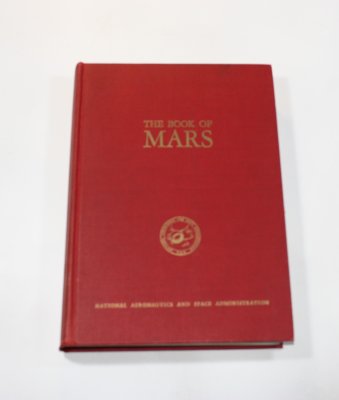
Samuel Glasstone's The Book of Mars represents a pivotal moment in planetary science, capturing NASA's cutting-edge understanding of the Red Planet during the Space Race era. This rare 1968 technical publication remains an essential document for collectors interested in early space exploration.
The Book of Mars: A Landmark in Planetary Science
Samuel Glasstone's The Book of Mars, published in 1968 by NASA's División Científica y Técnica (Scientific and Technical Division) in Washington DC, stands as one of the most comprehensive and authoritative treatments of Martian science produced during the Space Race era. This octavo volume, spanning 315 pages of dense scientific inquiry, represents a watershed moment when humanity's understanding of our neighboring planet underwent radical transformation.
In 1968, Mars remained largely mysterious. The famous Mariner 4 spacecraft had provided humanity's first close-up images just three years earlier, shattering romantic notions of Martian canals and civilizations. Glasstone's work synthesized all available scientific knowledge to create an authoritative reference that would inform the subsequent decades of Mars exploration. The book's timing proved crucial—published just as NASA was preparing for the Apollo missions while simultaneously planning advanced robotic exploration of Mars.
Samuel Glasstone: The Master of Scientific Communication
Samuel Glasstone (1900-1982) was one of the twentieth century's most prolific scientific writers, an expert at translating complex scientific concepts for educated audiences. His background in nuclear chemistry and physics gave him credibility within the scientific establishment, while his gift for clear exposition made technical material accessible. Before The Book of Mars, Glasstone had already distinguished himself through numerous publications on nuclear energy and space science, making him an ideal choice to synthesize Martian research for NASA.
Contents That Changed Our Understanding
The chapters contained within this volume reveal the sophistication of 1960s planetary science. Detailed examinations of the Martian atmosphere—then believed to be far denser than we now know—sit alongside rigorous analysis of surface geology and topography. Glasstone devoted considerable attention to atmospheric phenomena including clouds and fog, subjects that would preoccupy scientists for decades. Particularly prescient are sections addressing the formation of prebiological materials and the possibility of extraterrestrial life, questions that remain central to contemporary astrobiology.
The numerous black and white illustrations throughout the volume constitute a visual archive of 1960s-era understanding of Mars. Diagrams, charts, and processed images from Mariner missions provide invaluable documentation of how scientists visualized the Red Planet before the detailed photographic surveys of later decades.
Why This Edition Remains Rare and Valuable
This official NASA technical publication exists in relatively limited quantities compared to commercial astronomy books. Its specialized nature meant distribution was primarily to research institutions, universities, and space agencies rather than general audiences. Original copies in good condition remain surprisingly scarce, making this a significant acquisition for serious collectors of space exploration literature and scientific history.
For astronomy enthusiasts, this book provides essential context for understanding how Mars science evolved. For collectors, it represents an authoritative document from NASA's most triumphant period. The Book of Mars endures as a testament to systematic scientific inquiry conducted at the threshold of the Space Age.
Works by this author in our catalogue