8 August 2026
Eugène Antoniadi's Revolutionary Mars: The 1930 Classic That Changed Planetary Astronomy
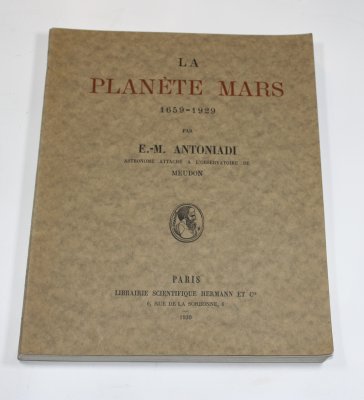
Discover why La Planete Mars remains a cornerstone work in astronomical history. This 1930 first edition by Greek-born astronomer Eugène Antoniadi definitively debunked the myth of Martian canals and established the cartographic standards that would endure into the space age.
A Masterwork from the Golden Age of Telescopic Astronomy
La Planete Mars, published in 1930, represents one of the most significant astronomical treatises of the twentieth century. This magnificent quarto volume, measuring 282 × 230 millimeters with 239 pages of text and 10 fine plates, stands as the definitive pre-spacecraft study of the Red Planet. For collectors of rare astronomical works and those fascinated by the history of planetary science, this first edition is an absolute treasure.
Authored by Eugène Antoniadi, a Greek-born astronomer of extraordinary skill and reputation, the book crystallizes decades of telescopic observation and rigorous scientific analysis. Antoniadi (1870–1944) was no ordinary observer; he served as subdirector of the observatory established by the legendary Camille Flammarion at Juvisy-sur-Orge, and he had access to the magnificent telescope at the Meudon Observatory, one of the finest instruments of its era.
Debunking Mars' Greatest Illusion
Perhaps the most historically significant aspect of La Planete Mars is its decisive refutation of the famous Martian canals controversy. For decades, astronomers had debated whether the straight lines observed on Mars—famously mapped by Giovanni Schiaparelli and Percival Lowell—represented actual artificial channels built by an advanced civilization. This speculation had captured public imagination and scientific attention alike.
Antoniadi, with meticulous empirical evidence and superior telescopic observations, demonstrated conclusively that these purported canals were optical illusions. Using the exceptional resolving power of the Meudon telescope, he proved that the linear features reported by other observers were products of the eye's tendency to connect disconnected surface features into regular patterns. This debunking was revolutionary, closing one of astronomy's most romantic—and misleading—chapters.
Cartography That Outlasted the Telescope
Beyond its role in dispelling myths, La Planete Mars provided Mars with its most accurate telescopic maps to date. Antoniadi's cartography of the Martian surface was so precise and comprehensive that it remained in use by astronomers and space agencies throughout the mid-twentieth century, even as spacecraft began returning actual photographic data. This remarkable longevity testifies to both Antoniadi's observational genius and the scientific rigor underlying his work.
The volume presents a complete analytical history of all Mars research conducted since 1659, making it an invaluable reference work for understanding the development of planetary astronomy. The publisher's printed boards, substantial page count, and beautiful plates reflect the importance placed on this edition.
Why This Edition Matters to Collectors
As a 1930 first edition of a foundational work by one of history's greatest planetary observers, this copy deserves a place in any serious collection of astronomical history or rare scientific books. Antoniadi's contributions fundamentally changed our understanding of Mars and scientific methodology itself. Today, with renewed interest in Mars exploration, La Planete Mars offers collectors and enthusiasts a direct connection to pre-spaceflight Mars study—a window into how previous generations of observers wrestled with celestial mysteries using only telescopes and the human eye.
Works by this author in our catalogue