10 August 2026
Witnessing the Universe's Greatest Discovery: Paul Couderc's 1950 Masterpiece on Cosmic Expansion

Explore Paul Couderc's groundbreaking 1950 treatise on universal expansion, a rare first edition that captures the pivotal moment when astronomy transitioned from static cosmology to dynamic models of an ever-growing cosmos.
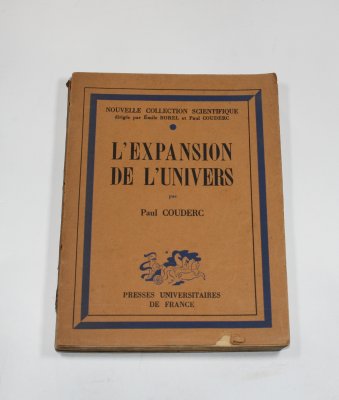
L'expansion de l'univers represents one of the most intellectually thrilling moments in twentieth-century astronomy—the definitive triumph of the expanding universe model over Einstein's initially preferred static cosmos. Paul Couderc's 1950 French-language treatise stands as an elegant and comprehensive examination of this revolutionary paradigm shift, making it an indispensable artifact for both serious collectors and astronomy historians.
The Author's Significance
Paul Couderc (1899-1981) was a distinguished French astronomer and prolific science writer whose career spanned the most transformative era in cosmology. Working at the Paris Observatory, Couderc possessed the rare gift of translating complex mathematical physics into accessible yet rigorous prose. By 1950, when he published this work, Couderc had already established himself as one of France's preeminent popularizers of modern astronomy, commanding the respect of both academic peers and educated general readers.
Historical Context and Scientific Revolution
The timing of this publication cannot be overstated. The late 1940s and early 1950s witnessed astronomy's wholesale acceptance of the expanding universe concept, driven by mounting observational evidence and the theoretical elegance of Friedmann-Lemaître models. Couderc's book captures this pivotal transformation with remarkable clarity. The work traces the intellectual journey from Einstein's static universe through de Sitter's modifications, ultimately arriving at the dynamic cosmologies that would dominate twentieth-century physics.
What distinguishes Couderc's treatment is his balanced presentation of competing theoretical frameworks. Rather than simply promoting one model, he systematically examines homogeneous models, non-homogeneous alternatives, and the crucial question of the cosmological constant—debates that remain relevant to contemporary cosmology, particularly with our modern understanding of dark energy.
The Physical Book and Its Treasures
This first edition arrives in an attractive orange publisher's binding, a charming detail of mid-century French scientific publishing. The octavo format, modest dimensions, and substantial 234-page count suggest a work intended for serious study rather than casual browsing. The book's pedagogical design is evident in its 34 integrated text figures illustrating complex concepts, complemented by an impressive twelve-page photographic section featuring astronomical plates—genuine period astronomical photography that connects readers to observational reality.
The organizational structure reflects Couderc's pedagogical mastery: moving from fundamental concepts of galactic distances and recession velocities through non-Euclidean geometry to competing universe models, concluding with evidence from primordial conditions. This progression builds logically toward understanding how the universe's density history connects observational phenomena ranging from stellar ages to cosmic rays.
Rarity and Collector Value
Original 1950 French editions of specialized scientific monographs rarely survive in good condition, making this complete copy with intact photographic plates particularly desirable. The specialized nature of Couderc's text—technical enough to appeal to astronomers, yet written in French—restricts its circulation beyond Francophone academic markets. Collectors seeking primary sources documenting mid-century cosmological understanding will find this volume invaluable, especially given the excellent preservation of both text and illustrations.
For astronomy enthusiasts and historians of science, L'expansion de l'univers represents a tangible connection to the moment when humanity definitively embraced a dynamic, evolving cosmos—perhaps the most consequential astronomical discovery of the modern era.
Works by this author in our catalogue