28 August 2026
The Falkauer Atlas: Hans Vehrenberg's Revolutionary Photographic Star Charts
Discover how Hans Vehrenberg's groundbreaking Falkauer Atlas democratized astronomy in the 1960s. This comprehensive photographic star chart collection remains a prized possession for collectors and amateur astronomers alike.
A Pioneer's Vision: Hans Vehrenberg and the Falkauer Atlas
In the early 1960s, amateur astronomy stood at a crossroads. While professional observatories possessed sophisticated equipment and detailed star catalogs, enthusiasts lacked practical, affordable tools for serious celestial observation. Enter Hans Vehrenberg, a visionary German astronomer and instrument maker whose creation would fundamentally transform amateur stargazing. The Falkauer Atlas, first published in 1962, represented nothing short of a revolution in astronomical reference materials.
Vehrenberg's innovation was deceptively simple yet profoundly effective: he compiled 303 detailed photographic star maps covering the northern celestial hemisphere. Each map, precisely formatted in A4 size, displayed individual sky fields measuring approximately 12 × 12 degrees, allowing observers to systematically navigate the heavens with unprecedented clarity. The atlas spanned from the north celestial pole down to a declination of -26°, providing comprehensive coverage of the skies visible from Central European latitudes.
Why the Falkauer Atlas Mattered Then and Now
What made the Falkauer Atlas truly remarkable was its accessibility. Published at a time when quality star atlases commanded premium prices, Vehrenberg's creation offered precision without extravagance. The photographic reproduction method, derived from actual astronomical plates, ensured accuracy while keeping production costs reasonable—making serious astronomy attainable for dedicated amateurs rather than wealthy professionals.
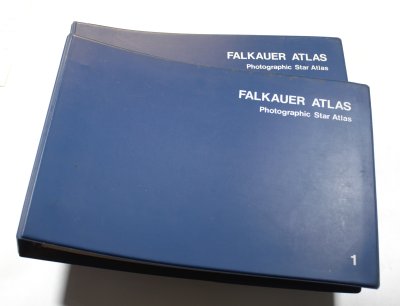
The atlas came elegantly packaged in two sturdy boxes, protecting its contents while maintaining portability for field observations. This practical design consideration reflected Vehrenberg's deep understanding of amateur astronomers' needs. Whether observing from a backyard telescope or a dark-sky site, users could reference the appropriate chart without cumbersome volumes.
The Legacy of a Rare Edition
The immediate success of the 1962 edition prompted a swift reprint in 1963, testament to its popularity among Central European astronomy clubs and institutions. Yet it is precisely this limited production run that makes original copies increasingly scarce today. The passage of sixty years has taken its toll—the atlas's paper quality, though durable, shows age, and many copies suffered heavy use by devoted observers whose markings and annotations now enhance their historical value.
For collectors, the Falkauer Atlas represents more than mere reference material; it embodies a pivotal moment in twentieth-century astronomy when technology democratized an ancient pursuit. Vehrenberg's atlas sits alongside other groundbreaking works in the evolution of practical astronomy, representing the bridge between professional science and passionate amateur observation.
Today's collectors value the Falkauer Atlas for multiple reasons: its historical significance in bringing quality star charts to amateurs, its elegant design and practical utility, and its rarity in fine condition. Whether you're a devoted astronomy historian, an active observer seeking authentic vintage reference tools, or a collector of scientific instruments' documentation, an original Falkauer Atlas remains a treasured acquisition—a tangible connection to astronomy's golden age of popular discovery.
Works by this author in our catalogue