30 August 2026
James Nasmyth's Lunar Photography: A Revolutionary First Edition That Changed Astronomy

Discover how Scottish astronomer James Nasmyth revolutionized lunar observation with his 1874 masterpiece, combining three decades of observations with innovative photographic techniques to create one of the first books illustrated with photomechanical processes.
A Visionary Approach to Capturing the Moon's Surface
When James Nasmyth published The Moon considered as a planet, a word, and a satellite in 1874, he fundamentally changed how astronomers could document and share their observations. This remarkable first edition represents far more than a scientific text—it stands as a pioneering achievement in both astronomical research and printing technology, making it an essential acquisition for serious collectors and astronomy enthusiasts alike.
Nasmyth, a brilliant Scottish astronomer, spent over thirty years meticulously observing the Moon's cratered, mountainous surface. Rather than rely solely on traditional astronomical drawings, he developed an ingenious solution to overcome the technical limitations of direct lunar photography. He sketched the lunar surface from his observations, then constructed detailed plaster models based on these drawings. By photographing these models against black backgrounds with carefully controlled raking light, Nasmyth produced remarkably faithful representations of the Moon's actual terrain.
The Legacy of a Scottish Master's Method
Nasmyth's innovative technique likely drew inspiration from his father, a renowned Scottish landscape painter who used plaster models as studies for his paintings. This artistic heritage merged beautifully with scientific precision, creating something entirely new in astronomical publishing. Contemporary critics hailed these images as among the most "truthful and striking representations of natural objects" ever produced for scientific study—a testament to the method's revolutionary effectiveness.
This 1874 first edition is particularly significant because it represents one of the earliest scientific books to be illustrated with photomechanical prints. The volume contains 23 Woodbury type plates alongside one chromolithographed plate, a heliographed frontispiece, and numerous text illustrations. The technical diversity speaks to the experimental nature of early photomechanical reproduction.
Why This Edition Remains Exceptionally Rare
The first three editions of Nasmyth's work employed varying reproduction processes—including engraving, photogravure, heliotype, lithography, chromolithography, and four different variations of Woodbury type. These variations suggest the first two editions may have served partly as experiments to determine the optimal reproduction method. By the third edition, publishers had settled on Woodbury type as their preferred technique, indicating the earlier editions' exploratory status.
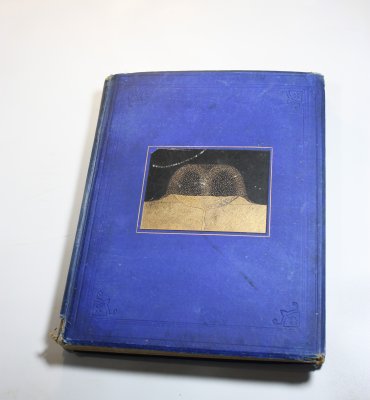
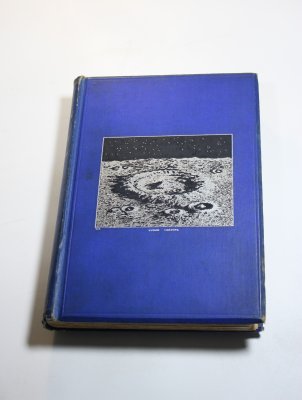
This particular first edition is bound in the publisher's original blue cloth with gilt vignette on the upper cover—a handsome presentation that has aged gracefully, showing only minor wear to the corners and spine. Published by the prestigious John Murray of London, this copy exemplifies the quality expected from one of Victorian publishing's most respected houses.
For collectors, this book represents an intersection of art, science, and printing history. It demonstrates how innovation in observation techniques combined with emerging photomechanical technologies could revolutionize scientific communication. For astronomy enthusiasts, it remains a fascinating window into nineteenth-century lunar studies and the ingenuity required to capture celestial detail before modern digital photography.
Acquiring an original 1874 first edition of The Moon offers collectors and scholars an opportunity to own a pivotal work in both astronomical history and the history of scientific publishing—a book that literally shaped how we visualize and understand our closest celestial neighbor.
Works by this author in our catalogue