23 August 2026
Josep Comas i Sola's Astronomia: A Landmark of Spanish Scientific Publishing
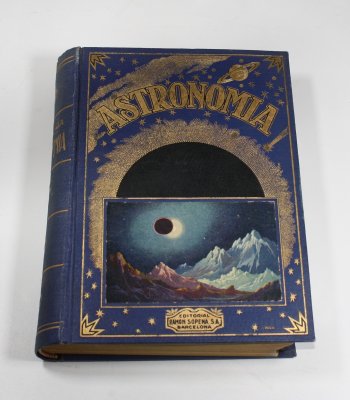
Discover why the 1935 Astronomia by Catalan polymath Josep Comas i Sola remains a treasured find for collectors. This comprehensive treatise on astronomy, astrophysics, and space exploration represents a golden age of Spanish scientific literature.
A Scientific Giant's Masterwork
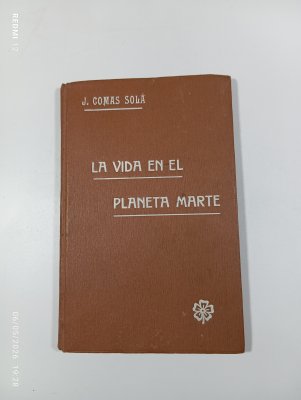
Josep Comas i Sola (1868-1937) stands as one of the most remarkable scientific figures of late 19th and early 20th-century Spain. Though he spent most of his career as a dedicated astronomer and meteorologist, Comas i Sola was equally renowned as an author, making the Astronomia of 1935 a fitting capstone to his prolific writing career. This comprehensive volume represents the culmination of decades of astronomical research and a fervent desire to share scientific knowledge with the Spanish-speaking world.
Published by the prestigious Editorial Ramon Sopena in Barcelona, this 640-page tome was part of the distinguished 'Biblioteca Hispania' collection—a series dedicated to publishing authoritative works on diverse subjects by leading Spanish intellectuals. The Sopena publishing house was known for its commitment to quality production values, and this particular edition exemplifies their attention to detail.
What Makes This Edition Exceptional
The 1935 Astronomia is far more than a simple stargazing guide. At 22 centimeters in height and bound in hardcover editorial binding, this substantial work encompasses three crucial fields: Astronomía (observational astronomy), Astrofísica (astrophysics), and Investigación espacial (space exploration). The inclusion of geodesy—the science of Earth's measurement and shape—further demonstrates Comas i Sola's comprehensive approach to celestial and terrestrial sciences.
What truly elevates this volume for collectors is its extraordinary collection of folded maps and engravings. In an era before digital illustration, technical astronomical diagrams and celestial charts required exceptional craftsmanship. The hand-engraved star maps and fold-out plates in this edition showcase the remarkable skill of early 20th-century illustrators and remain visually stunning to contemporary viewers.
Historical Significance
Published just two years before Comas i Sola's death in 1937, this work captures the state of astronomical science during a fascinating transitional period. Written during an era when radio astronomy was emerging and when our understanding of the cosmos was rapidly expanding, the volume bridges classical observational astronomy with modern astrophysical inquiry. For Spanish scholars, this represented cutting-edge scientific literature.
The timing of publication is particularly poignant: the Spanish Civil War would erupt mere months after this book's release, eventually disrupting Spain's scientific and intellectual life for decades. Consequently, many copies were lost or damaged, making surviving examples increasingly scarce.
Why Collectors Seek This Edition
Collectors prize this volume for several compelling reasons. First, it represents Spanish scientific achievement during a crucial historical moment. Second, its production quality—the binding, maps, and engravings—reflects a level of craftsmanship increasingly rare in modern printing. Finally, as a comprehensive scientific treatise by a genuine polymath, it offers genuine intellectual value alongside its bibliographic merit.
For astronomy enthusiasts, owning Comas i Sola's Astronomia connects them to a rich tradition of Spanish scientific thought and provides fascinating insights into how astronomical knowledge was presented to educated readers in the 1930s.
Works by this author in our catalogue