27 August 2026
Hubble's Legacy in Print: Why the 1961 Atlas Remains Essential for Serious Collectors

Discover why Allan Sandage's groundbreaking Hubble Atlas of Galaxies stands as one of astronomy's most important visual references. This exploration of the 1961 original and its 1983 reprint reveals why collectors prize these editions.
A Foundation Stone of Modern Astronomy
Few books have shaped our understanding of the cosmos as profoundly as The Hubble Atlas of Galaxies. Published in 1961 by the Carnegie Institution of Washington, this monumental work represents a pivotal moment when astronomy transitioned from theoretical speculation to systematic visual cataloging. Allan Sandage, building upon Edwin Hubble's revolutionary observations and classification system, created a reference work that became the standard for galaxy morphology for generations of astronomers.
The Visionary Behind the Atlas
Allan Sandage inherited both the scientific legacy and the observational data of Edwin Hubble, the legendary astronomer who fundamentally changed our conception of the universe's scale. Rather than simply republishing Hubble's earlier work, Sandage undertook the ambitious task of revising and expanding Hubble's original galaxy classification scheme. Drawing from his own meticulous research and Hubble's extensive photographic archives, Sandage created a comprehensive visual taxonomy that reflected decades of telescopic observation. This wasn't mere compilation—it was scholarly synthesis at the highest level, combining historical precision with contemporary astronomical understanding.
Why This Edition Matters for Collectors
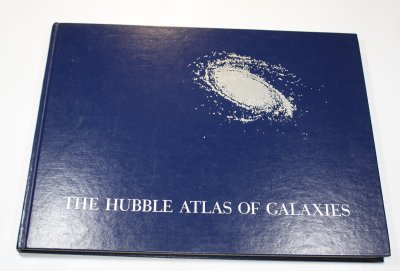
The 1961 first edition of this atlas is a remarkable artifact of mid-twentieth century scientific publishing. Its large format was specifically designed to accommodate stunning photographic plates from the Mount Wilson and Palomar observatories—images of galaxies captured by the most powerful telescopes of the era. These weren't mass-produced reproductions; they represented the cutting edge of astronomical photography. The 1983 reprint, which this exemplar represents, has become increasingly valuable as it bridges historical and practical significance. Published during the digital revolution's dawn, this reprint maintained the original's essential character while serving a new generation of researchers and collectors.
The Physical Treasure
This particular copy, in very fine condition with no markings, represents exactly what serious collectors seek. Unlike heavily used library copies or volumes bearing the marks of intensive study, this pristine example suggests it was carefully preserved—possibly by someone who recognized its enduring value. The absence of marginalia, stamps, or wear indicates it has been stored appropriately, preserving the photographic plate clarity that makes the atlas genuinely useful rather than merely decorative.
Scientific Importance Meets Collecting Appeal
What makes the Hubble Atlas exceptional is the convergence of multiple collecting interests. Historians of astronomy prize it as a document of how classification systems evolve. Cosmology enthusiasts value it as visual evidence of the universe's structure as understood in the early space age. Rare book collectors appreciate its production quality and the marriage of art and science in its photographic plates. The work appears regularly in exhibitions of important scientific books, yet true fine copies remain surprisingly difficult to locate.
For collectors seeking a single volume that captures a transformative moment in astronomical science—when we first began systematically categorizing the billions of galaxies surrounding us—The Hubble Atlas of Galaxies is an essential acquisition. This 1983 reprint, in pristine condition, offers an opportunity to own a piece of scientific history that remains scientifically relevant and visually magnificent.
Works by this author in our catalogue