13 September 2026
Pierre Gassendi's Institutio Astronomica: A Bridge Between Ancient and Modern Cosmos

Discover the rare 1656 Gassendi masterpiece that reconciled classical astronomy with Copernican and Tychonic systems. This exceptional Vlacq edition from Owen Gingerich's legendary collection represents a pivotal moment in astronomical history.
A Philosopher's Triumph: Gassendi's Revolutionary Synthesis
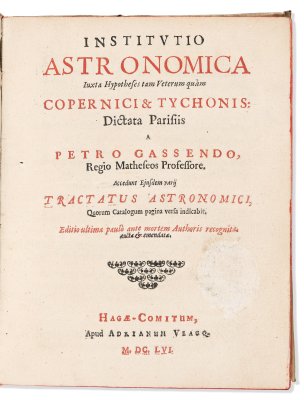
Pierre Gassendi's Institutio Astronomica iuxta Hypothesis tam veterum quam Copernici et Tychonis stands as one of the most intellectually ambitious astronomical treatises of the seventeenth century. Published in 1656 by the esteemed Hague printer Adrianum Vlacq, this folio volume represents far more than a simple astronomical manual—it embodies a philosophical reconciliation between the ancient geocentric worldview and the revolutionary heliocentric models that were transforming human understanding of the cosmos.
Gassendi, a French philosopher, mathematician, and astronomer of extraordinary talent, possessed a rare ability to navigate the treacherous intellectual currents of his era. While many of his contemporaries were forced to choose between traditional Aristotelian astronomy and the radical Copernican system, Gassendi constructed a sophisticated framework that honored both historical achievement and empirical innovation. His inclusion of Tycho Brahe's geocentric model—a middle ground between Ptolemy and Copernicus—demonstrates the nuanced approach that earned him respect across Europe's competing philosophical schools.
The Vlacq Edition: A Collector's Prize
This particular 1656 Vlacq printing occupies a special place in astronomical bibliography. The La Haya edition, with its striking red and black printed title page and numerous full-page xylographic diagrams, represents the pinnacle of seventeenth-century scientific book design. The engraved portrait of Gassendi bound before the text serves as a tangible connection to the brilliant mind that conceived this work, while the elaborate woodcut illustrations—many occupying entire pages—make abstract astronomical concepts viscerally comprehensible to the educated reader.
The eighteenth-century vellum binding, though showing the inevitable wear of nearly four centuries, testifies to the volume's scholarly pedigree. The gilded tool work depicting a saint on the front board reflects the reverent regard in which learned books were held during the binding's era. Even the signs of time—the slightly worn seals, the punch hole on the front board—tell stories of intensive study and careful preservation across generations.
Provenance That Elevates Value
Perhaps most significantly, this copy comes from the collection of Owen Gingerich, the legendary Harvard astronomer, historian, and bibliophile whose personal library became one of the most distinguished private collections of rare astronomical and mathematical works. Gingerich's meticulous scholarship and impeccable taste in acquisition established benchmarks for serious collectors worldwide. That this particular copy bore his scholarly attention imbues it with an aura of authentication and historical weight that few antiquarian books can claim.
For collectors seeking a seminal work in the history of astronomy—one that captures the moment when science was fundamentally reconceiving humanity's place in the universe—Gassendi's Institutio Astronomica represents an exceptional acquisition. It is simultaneously a beautiful artifact of Renaissance printing, a landmark in philosophical thought, and a tangible link to the heroic age of astronomical discovery. In the rarified world of significant scientific incunabula, this Vlacq edition deserves its place among the most coveted volumes.
Works by this author in our catalogue