22 August 2026
Gassendi's Astronomical Masterpiece: A Bridge Between Ptolemy, Copernicus, and Tycho Brahe
Discover the rare 1656 Hague edition of Pierre Gassendi's groundbreaking Institutio Astronomica, a pivotal work that presented competing cosmological models to Early Modern readers. This exquisitely bound volume from Owen Gingerich's collection bridges ancient and revolutionary astronomical theories.
A Scholar's Synthesis of Cosmic Models
Pierre Gassendi's Institutio Astronomica stands as one of the most intellectually ambitious astronomical treatises of the seventeenth century. First published in 1647 and reprinted in this magnificent 1656 Hague edition, Gassendi's work represents a rare moment in scientific history when an accomplished scholar attempted to present multiple competing cosmological systems with scholarly rigor rather than partisan fervor.
Gassendi (1592-1655), the distinguished French astronomer, philosopher, and Catholic priest, possessed a unique intellectual position during an era of fierce astronomical controversy. Rather than demanding allegiance to a single model of the cosmos, his Institutio Astronomica systematically explores three major theories: the ancient Ptolemaic geocentric system, the revolutionary heliocentric model of Copernicus, and the ingenious compromise system devised by Tycho Brahe. This tripartite approach was remarkably progressive for its time, allowing educated readers to evaluate the evidence and arguments for themselves.
The Physical Beauty of This Edition
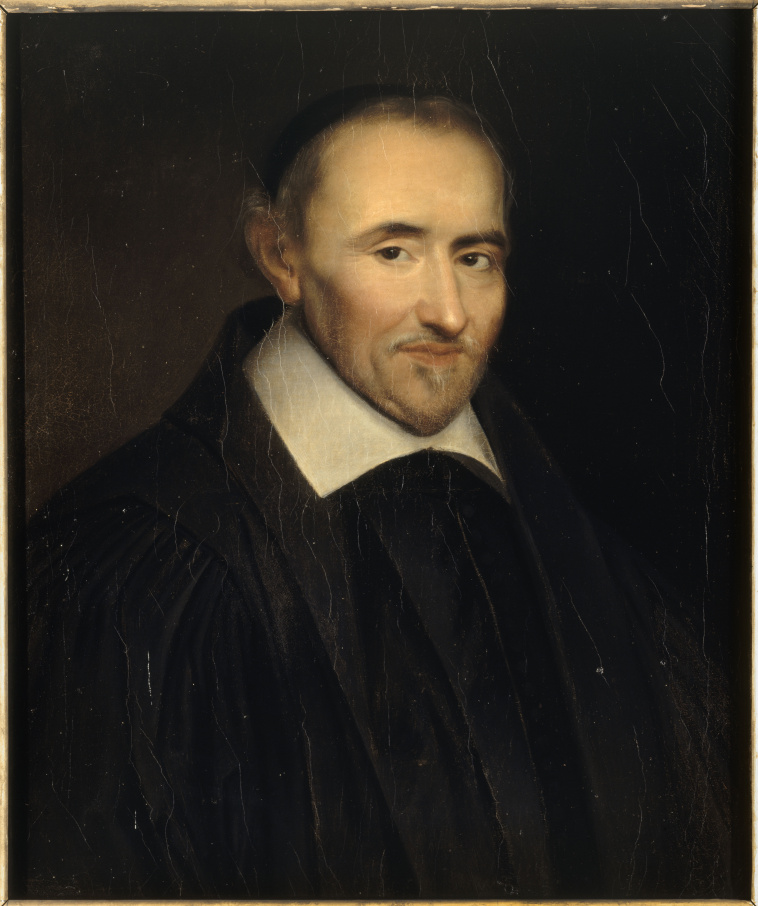
The 1656 Vlacq edition from The Hague represents a triumph of Early Modern printing and bookbinding. This in-quarto volume features an engraved portrait of Gassendi bound at the front, setting an authoritative tone for the scholarly work that follows. The title page, printed in the distinctive red and black characteristic of prestigious seventeenth-century printing, announces the work's comprehensive scope immediately.
The text is richly illustrated with numerous woodcut diagrams, many occupying full pages, which clearly demonstrate the geometric principles underlying each cosmological model. These xylographic illustrations serve not merely as decoration but as essential pedagogical tools, allowing readers to visualize the celestial mechanics being described.
This particular copy is bound in full eighteenth-century parchment over boards with elaborate gilt tooling on the front board depicting a saint, representing the taste and resources of a learned collector. The volume's provenance as part of Owen Gingerich's legendary collection—the Harvard historian and astronomer renowned for his expertise in rare astronomical books—significantly enhances its desirability among serious collectors.
Why This Copy Matters to Collectors
Several factors render this 1656 edition particularly valuable. First, the Vlacq printing from The Hague represents one of the most carefully produced editions, benefiting from the Dutch publishing industry's reputation for quality. Second, this copy exhibits the signs of genuine historical use and appreciation: altered or removed bookplates suggest previous scholarly ownership, while the physical wear tells stories of careful handling by learned readers.
Most importantly, Gassendi's balanced presentation of competing astronomical theories represents an intellectual stance that would soon become impossible. After the work of Newton and the triumph of heliocentric mechanics, the Ptolemaic and Tychonic systems faded into historical curiosities. Owning this 1656 edition means possessing a window into a vanished moment when the nature of the cosmos remained genuinely open to debate among reasonable scholars.
For collectors of rare astronomy books and those fascinated by the Scientific Revolution, this Institutio Astronomica embodies both intellectual significance and physical beauty—a transformative work presented in a binding worthy of its contents.