22 July 2026
Peuerbach's Celestial Revolution: The 1534 Venetian Edition of Novae Theoricae Planetarum
Discover why Georg von Peuerbach's groundbreaking astronomical treatise remains a cornerstone of rare book collecting. This 1534 Venetian edition represents a pivotal moment in the history of planetary theory and Renaissance scientific thought.
A Monument to Medieval and Renaissance Astronomy
Georg von Peuerbach's Novae Theoricae Planetarum stands as one of the most influential astronomical works of the Renaissance, bridging the gap between Ptolemaic tradition and the emerging heliocentric revolution. The 1534 Venetian edition printed by Melchiorem Sessa represents a watershed moment in the dissemination of astronomical knowledge, making it an essential acquisition for serious collectors of scientific incunabula and early modern astronomy texts.
The Author's Legacy
Georg von Peuerbach (1423–1461) was an Austrian-German mathematician and astronomer whose contributions fundamentally transformed astronomical education throughout Europe. Though he lived only thirty-seven years, Peuerbach established himself as one of the most respected astronomers of his age, serving as court astronomer and mathematics professor in Vienna. His Novae Theoricae Planetarum, first published posthumously in 1472, presented the planetary motions with unprecedented clarity and mathematical rigor, displacing inferior medieval texts and becoming the standard astronomical textbook for generations of scholars.
The Significance of This 1534 Edition
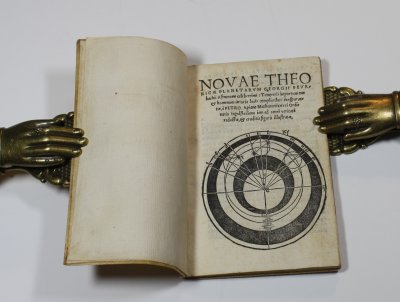
This particular Venetian edition is the first edition printed in Venice, marking an important distinction in the work's publication history. Venice, during the sixteenth century, was a dominant center of scholarly printing, and Melchiorem Sessa was among the city's most accomplished printers. The second edition status combined with its Venetian provenance makes this volume particularly desirable to collectors. The small octavo format (14.5 x 9.5 cm) made it portable and practical for working astronomers and students—a significant advantage in an era when large folio volumes dominated academic discourse.
Notable Features and Condition
This copy exhibits several features that enhance its value to discerning collectors. The striking large woodcut diagram on the title page immediately announces the work's technical sophistication, while the text illustrations featuring woodcuts demonstrate the printer's commitment to clarity in presenting complex astronomical concepts. The binding in supple parchment is both functional and elegant—characteristic of the period's practical approach to preserving intellectual treasures. The volume's excellent condition, with well-preserved woodcuts and sound pages, speaks to its careful handling throughout the centuries.
Provenance and Collectibility
The presence of the ex libris of Professor Owen Gingerich—renowned astronomer, historian of astronomy, and legendary rare book collector—significantly enhances this volume's provenance and appeal. Gingerich's collection represents one of the most carefully curated assemblages of astronomical literature ever amassed by an individual scholar, and association with his library is a mark of scholarly authentication and significance. His careful stewardship ensured that this sixteenth-century treasure was preserved with the respect it deserves.
Why Collectors Should Care
For collectors of rare scientific books, history of astronomy, or Renaissance learning, this 1534 Novae Theoricae Planetarum represents an extraordinary opportunity. It embodies the moment when astronomical knowledge began its revolutionary transformation, captured in a beautifully printed, highly functional format by one of Europe's greatest printers. The combination of historical importance, technical sophistication, excellent condition, and distinguished provenance makes this edition a cornerstone acquisition for any serious collector.
Works by this author in our catalogue