20 August 2026
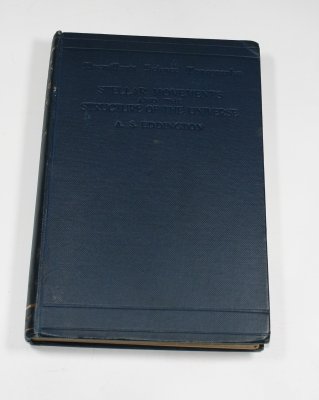
A Window into the Cosmos: Eddington's Revolutionary 1914 Masterpiece on Stellar Movements

Discover why Arthur Stanley Eddington's 1914 'Stellar Movements and the Structure of the Universe' remains one of the most significant astronomical treatises ever published, and why collectors prize this first edition.
The Birth of Modern Cosmology
In 1914, Sir Arthur Stanley Eddington published what would become one of the most influential astronomical works of the twentieth century: Stellar Movements and the Structure of the Universe. This groundbreaking monograph represented far more than a simple compilation of previously published research—it was nothing less than a comprehensive reshaping of humanity's understanding of our place in the cosmos.
Eddington, already a respected astrophysicist at Cambridge University, synthesized approximately fifteen scholarly articles that had appeared in the Monthly Notices of the Royal Astronomical Society between 1906 and 1914. What makes this 1914 first edition particularly remarkable is how Eddington managed to distill complex cosmological knowledge into a cohesive narrative that addressed the most pressing astronomical questions of his era. The result was a work that would influence generations of astronomers and remains essential reading today.
A Bold Hypothesis About Spiral Nebulae
Perhaps most significantly, Eddington used this platform to champion a controversial theory: that spiral nebulae were not merely clouds of gas within our own galaxy, but rather entire galaxies unto themselves, existing far beyond the Milky Way. This speculation, though not universally accepted at the time, would ultimately prove correct and fundamentally transformed our understanding of the universe's scale and structure.
The sheer audacity of this proposition cannot be overstated. At a time when most of the astronomical community still debated whether spiral nebulae were interior or exterior to our galaxy, Eddington presented a compelling case for the latter interpretation. His thoughtful analysis and reasoned arguments helped pave the way for what would later become the consensus view—one that revealed our galaxy as merely one island among billions in an incomprehensibly vast universe.
Why This Edition Matters to Collectors
This first edition holds exceptional value for serious collectors of astronomical history. Bound in cloth with gilt lettering on the spine, this copy presents in remarkably fine condition—internally clean with no marks or signs of heavy handling. The 266 pages are accompanied by four plates that provide valuable illustrations of stellar data and cosmological concepts. The pristine state of this edition is particularly noteworthy, as many copies from this period show considerable wear from intensive scholarly use.
Beyond its physical qualities, the rarity lies in its historical position at the dawn of modern cosmology. Published just four years before Eddington's famous 1919 solar eclipse expedition that would validate Einstein's General Relativity and establish him as a public intellectual, this monograph showcases his original scientific contributions before widespread fame altered his career trajectory.
A Testament to Scientific Vision
Collectors who acquire this volume obtain not merely a rare book, but a window into a transformative moment in astronomical science. Eddington's willingness to embrace speculative cosmology while maintaining rigorous scientific standards set a precedent for modern astrophysics. For anyone passionate about the history of astronomy or the development of twentieth-century science, this 1914 first edition represents an irreplaceable artifact—a direct connection to the mind of one of history's greatest astronomers at a crucial moment in his career.
Works by this author in our catalogue